Dear MFiX team,
I am running a 3D TFM simulation of a cold bubbling fluidized bed using MFiX 25.2.1. The main setup is as follows:
| Parameter | Value |
|---|---|
| Geometry | Vertical cylindrical bed |
| Column diameter | 0.06 m |
| Computational domain height | 0–1.40 m |
| Geometry method | Cartesian grid / cut-cell with STL cylinder |
| Gas inlet | Bottom mass inlet 2.7m/s |
| Outlet | Top pressure outlet |
| Wall boundary | CG_NSW cut-cell wall |
| Drag model | Gidaspow |
| Frictional stress model | Schaeffer |
| Solid phase | Iron ore particles |
| Particle diameter | approximately 0.85 mm |
| Particle density | approximately 3500–3900 kg/m³ |
| Initial solids volume fraction | approximately 0.58–0.6, depending on bed mass |
| [lunwenxz.mfx | attachment](upload://zPEE3s6B5CS7LB64KHNN9mBcoqc.mfx) (10.8 KB) |
Question 1: Mesh quality
MESH_STATS .TXT (77.0 KB)LOG
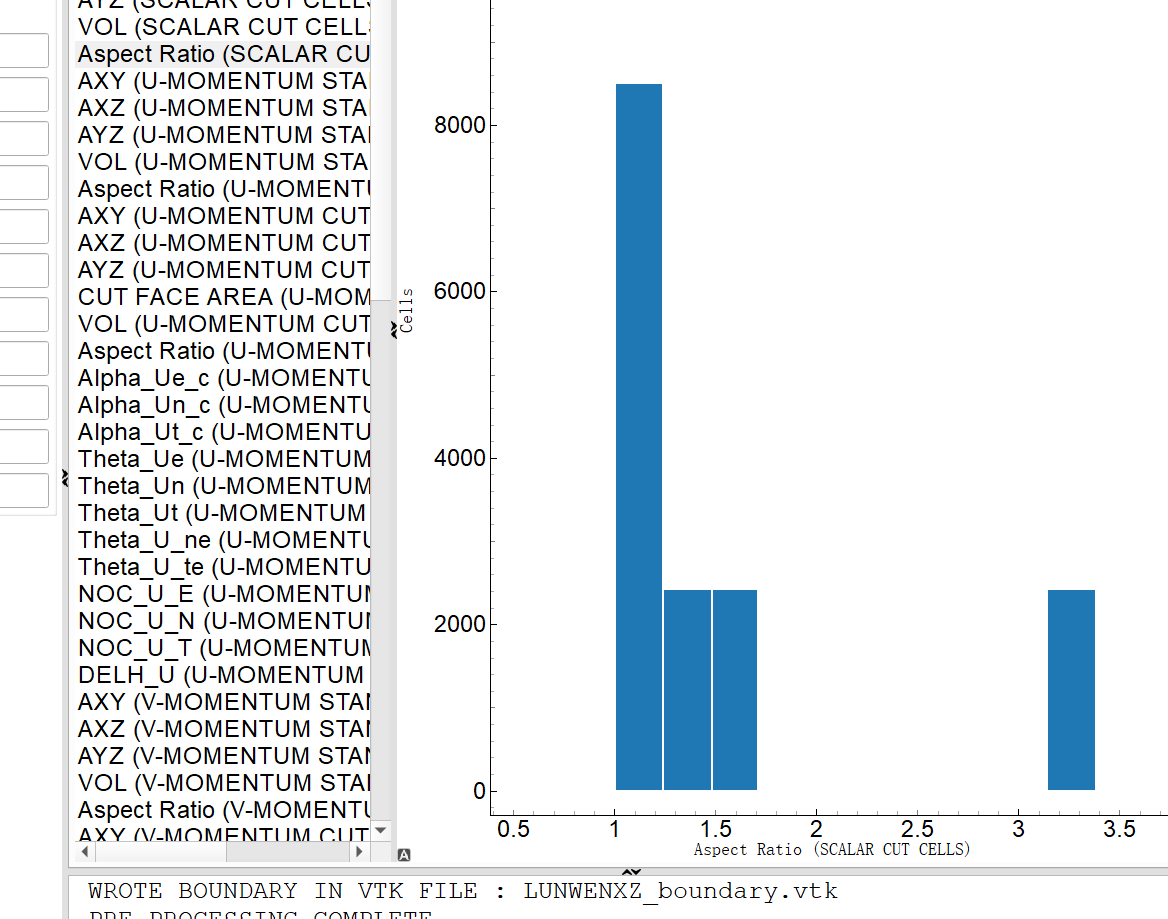
For this cylindrical cut-cell geometry, most scalar cut cells have an aspect ratio close to 1–1.5, but some cut cells still show aspect ratios around 3–3.5. How can I further improve the cut-cell mesh quality and reduce these high-aspect-ratio cells? Should I mainly increase the STL cylinder side number, adjust the background Cartesian mesh size, shift the cylinder relative to the Cartesian grid, or use a coarser mesh?
Question 2: Partial-slip wall condition
In the 3D Cartesian cut-cell model, I am using a CG_NSW wall boundary for the cylindrical wall. Does MFiX support solid-phase partial-slip wall conditions for 3D Cartesian cut-cell boundaries? If not, what is the recommended way to represent wall friction, specularity, or partial slip of solids along an acrylic cylindrical wall?

Question 3: Time step and DMP decomposition
In my simulations, the adaptive time step is usually around (10^{-4})–(10^{-5}) s, especially for higher bed inventory or stronger bubbling cases. Is this time-step range reasonable for a 0.06 m diameter TFM bubbling bed with 0.85 particles and gas velocity around2.6-2.7m/s? Also, for a mesh with about (1\times10^5)–(2\times10^5) total cells, would using 64 or 96 DMP cores improve the speed, or would MPI communication become inefficient because the number of fluid cells per core is too small? For a slender vertical cylinder, what DMP partition is recommended? For example, is nodesi × nodesj × nodesk = 2 × 24 × 2 reasonable for 96 cores, or should I avoid too much decomposition in the vertical (y)-direction?
D08.TXT (4.7 MB)
Thank you very much for your help