If you would like to contribute to our gallery, please contact us.
Microstructure Evolution Using Solid Mechanics
Simulation of microstructure evolution in a polycrystalline solid using Alamo
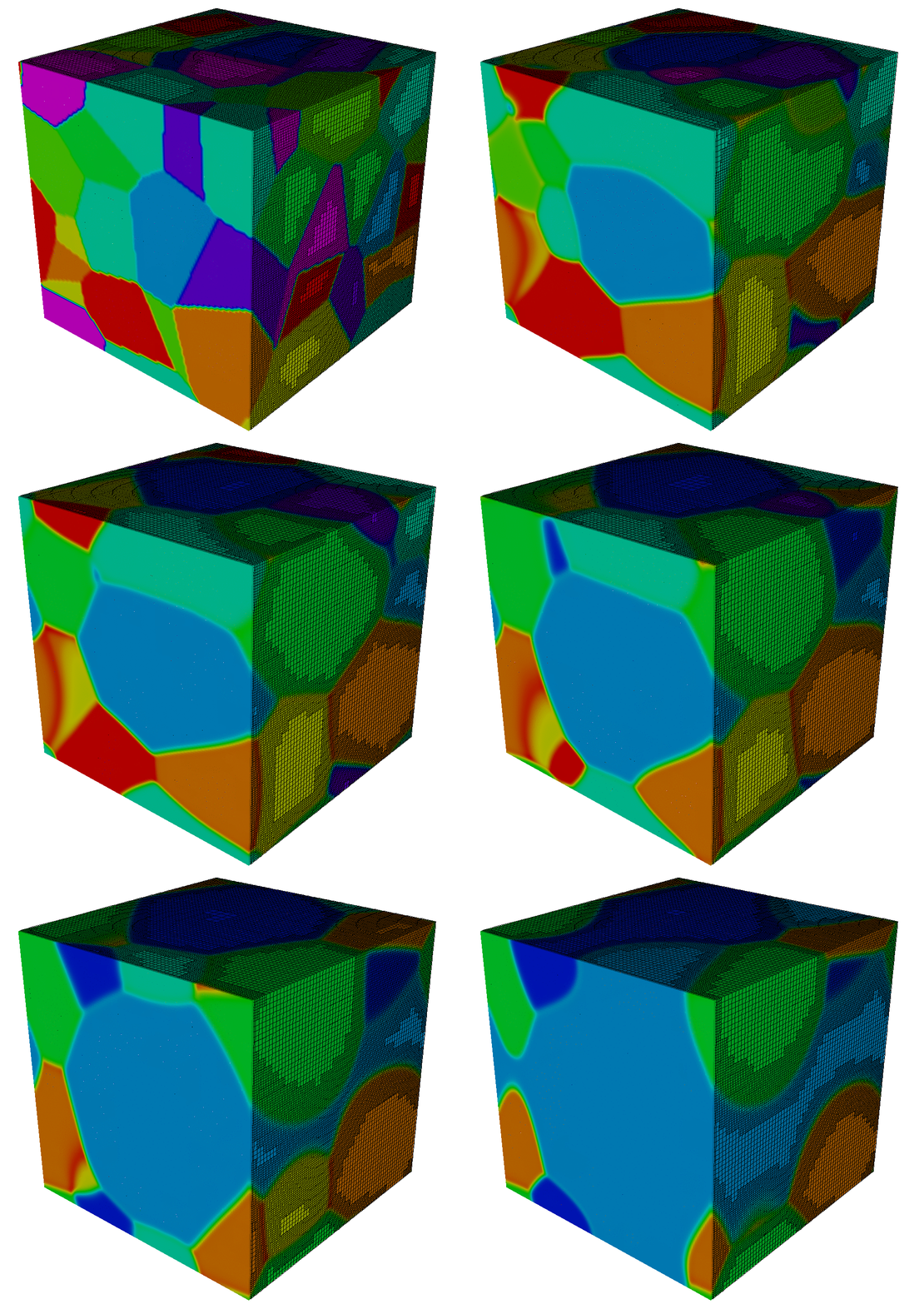
In this simulation,
the multiphase field method is used and the evolution equation is integrated explicitly.
Microstructure evolution is driven by boundary curvature (as in high temperature annealing) which causes coarsening.
The microstructure is initialized using a Voronoi tesselation with 40 initial grains.
The simulation has three levels of mesh refinement,
and was run on the Texas Advanced Computing Center Stampede2 computer with 512 MPI processes for 10 hours.
Image courtesy of Brandon Runnels, Multiscale Materials Modeling Group, University of Colorado, Colorado Springs, CO.
Modeling Compressible Reactive Gas DynamicsDetonation Propagation and Failure
Simulation of detonation propagation and failure by diffraction with HyBurn. The detonation is initiated in a reactant layer bounded by high-temperature products that have a very low acoustic impedance. The simulation used with 6 levels of refinement with a refinement ratio of 256 between the finest and coarsest levels. The detonation is initiated by a series of high-pressure, high-temperature spots. The detonation propagates steadily until it encounters a step change in the height of the reactant layer. The leading shock of the detonation weakens as it diffracts around the step, resulting in a decoupled shock and flame. The movie shows the temperature field and follows the detonation.
Image courtesy Brayden Roque, Hsiao-Chi Li, and Ryan Houim